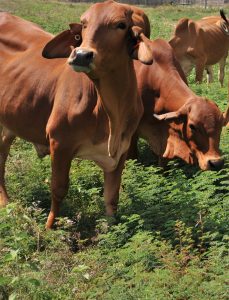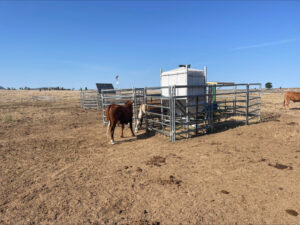
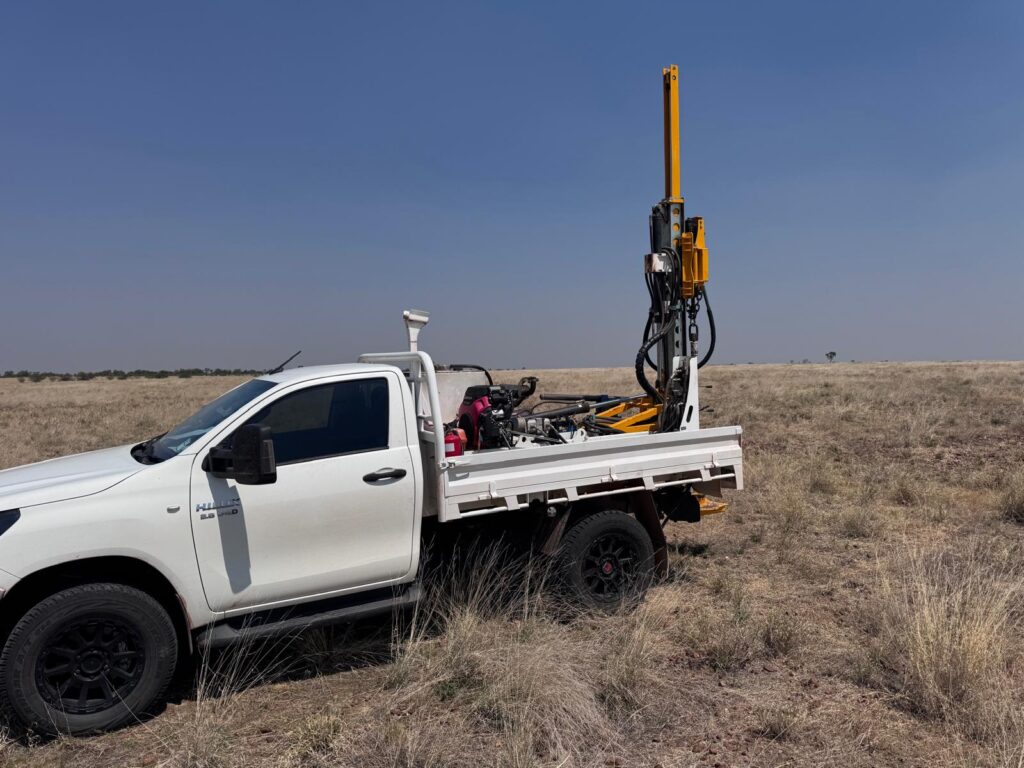
In paired paddocks across Queensland, those sown to Desmanthus held 7.5 tonnes more soil carbon per hectare, to a metre deep, than neighbouring paddocks without it. That’s the main finding from research Agrimix commissioned to answer a question from our Founder, Nick Kempe.
Nick had spent years watching Desmanthus do its work across northern paddocks — persisting on hard clay soils where other legumes give up, fixing nitrogen, and putting weight on cattle. But one question kept nagging him: what was it doing to the carbon in the soil beneath it?
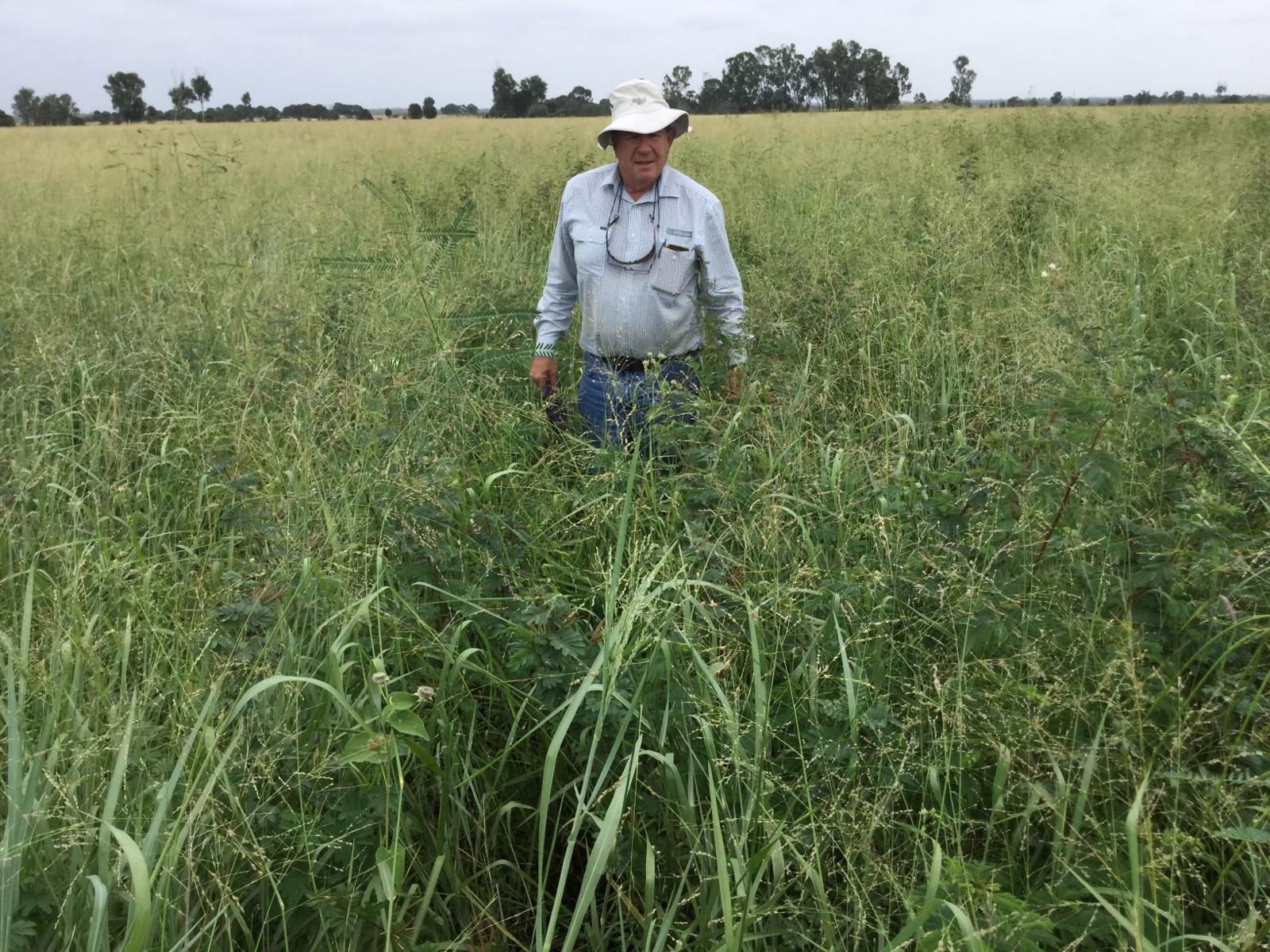
So we backed the work to find out. Partnering with Meat & Livestock Australia and a team at the Queensland University of Technology led by Associate Professor David Rowlings, we funded a study to put a real number on it. The results are now published in Soil Research.
What the research found
The QUT team used a paired-site approach across 12 locations in Queensland, chosen from 30 sites surveyed between the Gulf of Carpentaria and New South Wales. At each site they compared a paddock sown to Desmanthus against a neighbouring paddock without it, matched as closely as possible for soil type, landform and land-use history. Soil carbon was measured on intact cores all the way down to a metre.
- +7.5 t more carbon per hectare to 1 m depth vs control (P < 0.001)
- 0.47 t carbon per hectare each year
- 10 yrs where most of the gain happens before nearing a steady state
Desmanthus paddocks held 7.5 tonnes more carbon per hectare to one-metre depth than their controls, a statisically significant result. Across an average stand age of 16 years, that works out to roughly 0.47 tonnes of carbon per hectare each year. Most of that accumulation happened in the first decade after establishment, before the system settled towards a new steady state. Importantly, the gains showed up at depth, not just near the surface, and carbon stored deeper in the profile tends to be more stable and less easily lost.
Measured on an equivalent soil mass basis, which corrects for differences in soil density between paddocks, the gain was 4.5 tonnes of carbon per hectare to an effective depth of 82 cm: smaller, but still highly significant (P < 0.001).
There was a nitrogen story too. Soil nitrogen was significantly higher under Desmanthus (about 12.5 kg per hectare per year) which feeds straight back into pasture productivity and helps explain the carbon result. More nitrogen drives more plant growth, more roots, and more carbon returned below ground. In a separate QUT pasture trial at Samford, the team also measured greater root density under Desmanthus down to a metre, and legume-rich organic matter breaks down into the kind of stable, mineral-bound carbon that sticks around.
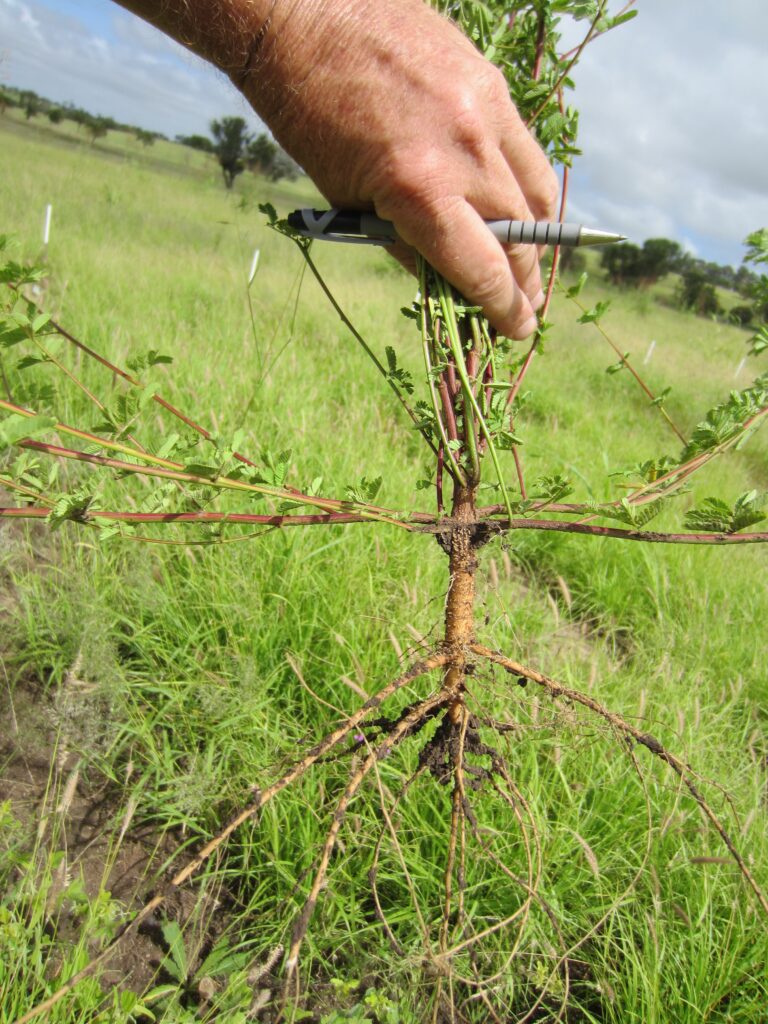
“We already knew Desmanthus earned its place above ground. This research confirms it’s building a carbon asset below ground too.”
Chloe Kempe, Director – Research and Commercialisation, Agrimix
Why it matters for the herd
Here’s where it gets interesting for beef producers. The researchers modelled those carbon gains against herd emissions and found a good Desmanthus stand could offset a meaningful slice of herd emissions – potentially 25–50% of the herd’s enteric methane where Desmanthus covers around a quarter of the grazing area, at stocking rates of 0.5–1 adult equivalent per hectare. That’s before you count the direct cut in methane from cattle eating Desmanthus: in our CSIRO trial, methane yield fell 8% and methane intensity 9% in the wet seasons. And none of it comes at the expense of production. The same pasture is putting weight on cattle.
Planting Desmanthus, or thinking about it? The productivity case has always stacked up. Now there’s a carbon case sitting underneath it — and it’s one worth understanding before farm carbon accounts and insetting programs mature. Talk to our agronomy team about getting a persistent stand established on your country.
It starts with a good stand
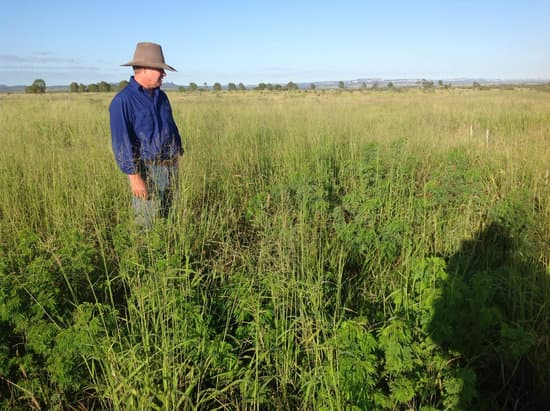
None of this happens without a good stand. Of the 30 historic Desmanthus paddocks the researchers surveyed, about 40% had too few plants to be included in the study. Seed is expensive, and seedlings have to compete with the pasture that’s already there. The carbon gains in this study come from paddocks where Desmanthus established well and persisted, so planning, seedbed preparation and sowing at the right time are what make the difference.
From “how much?” to “prove it on my place”
Answering the question at a regional scale is one thing. Quantifying it paddock-by-paddock, on a specific property, with the rigour that carbon markets demand, is another, and it’s the next problem we set out to solve. As part of the same Carbon Storage Pathways initiative, Agrimix and MLA co-funded QUT to develop Agrimix Flux: a measure-model-verify tool built to monitor pasture performance and soil carbon change under systems like Desmanthus.
That matters because a regional average can’t prove anything about your place. The 7.5 tonnes in this study is an average across 12 paired sites. If you want to claim carbon removals, whether that’s for ACCUs, an insetting program or your own farm carbon account, you need evidence from your own paddocks: what the soil carbon was when you started, how it has changed since, and what management drove the change.
Agrimix Flux is a Tier 3 approach, the most detailed level under IPCC guidelines. Rather than relying on default factors or national averages, it models soil carbon on your own paddocks. It pairs the world leading process-based soil carbon model, DayCent CABBI, with real-world eddy-covariance flux measurements to calibrate it – so instead of a single average number, you can attribute soil carbon change to what’s actually driving it on your country. That’s exactly the kind of defensible, driver-level accounting that carbon markets, supply chains, banks and auditors increasingly require.
Measure · Model · Verify — Quantify the carbon under your Desmanthus with Agrimix Flux. The research shows Desmanthus builds soil carbon. Agrimix Flux tells you how much of it is happening on your place, and why. If you’re weighing up a carbon project, an insetting claim, or simply want to know what your pastures are doing below ground, this is where to start. Talk to us about Agrimix Flux →
This research was funded by Meat & Livestock Australia and Agrimix as part of the Carbon Storage Pathways initiative. The full paper — Rowlings et al. (2026), “Soil carbon sequestration under the tropical perennial legume Desmanthus in northern Australian grasslands” — is open access in Soil Research.