Lachlan Godson, Pasture Agronomist and Researcher, Agrimix
Back in September, not many of us would have picked flooded roads in the middle of a record El Niño. But that’s where we are. Since mid-October, a lot of Queensland has had its best rain in eight months or more. There were falls of 50 mm plus from the Gulf down through the Central Highlands, big totals from Charleville up to Hughenden (171 mm in three days south of Tambo), and up to 200 mm in the south-east storms on 22 October.
This El Niño is still getting stronger. The Pacific is already warmer than it got at the peak of the big 2015–16 event, and it’s expected to keep warming until November or December. It’ll likely hang around into autumn next year, but it usually has less say over our rain once the wet season kicks in.
There’s a second dry signal too. The Indian Ocean is lining up in a way that usually points to less rain inland and down south. That one usually fades by early summer as well.
El Niño can still be wet
El Niño tips the odds towards a hotter, drier summer. It doesn’t turn the tap off. In the last El Niño, in December 2023, Cyclone Jasper flooded far north Queensland and storms hit the south-east. The last few weeks have been another reminder.
An El Niño isn’t a forecast for any one place. The Bureau’s latest outlook for November to January (issued 29 October) actually leans wetter for central and southern Queensland, northern NSW, south-west WA and central southern Australia. Tasmania, parts of southern Victoria and much of the tropical far north lean drier. It’s also likely to be hotter than normal pretty much everywhere, so any rain that falls will likely evaporate quicker.
That leaves two things to think about: the paddock and the market.
In the paddock
The rain has given most paddocks a good kick along, but a hot, dry run could still follow. A dry season can help show which paddocks perform better than others. It’s a bit like cattle. In a hard season you can see which ones do better, while in a good season those differences can be hidden. The paddocks that hold up may be worth looking after, and the ones that struggle may be worth a closer look once the season settles.
This summer may not be the time to rush into sowing. Seed and establishment isn’t cheap, and a new pasture will likely need follow-up rain to establish. The best results usually come from sowing when there’s good stored soil moisture and the outlook backs it up with a high chance of follow-up rainfall.
In the market
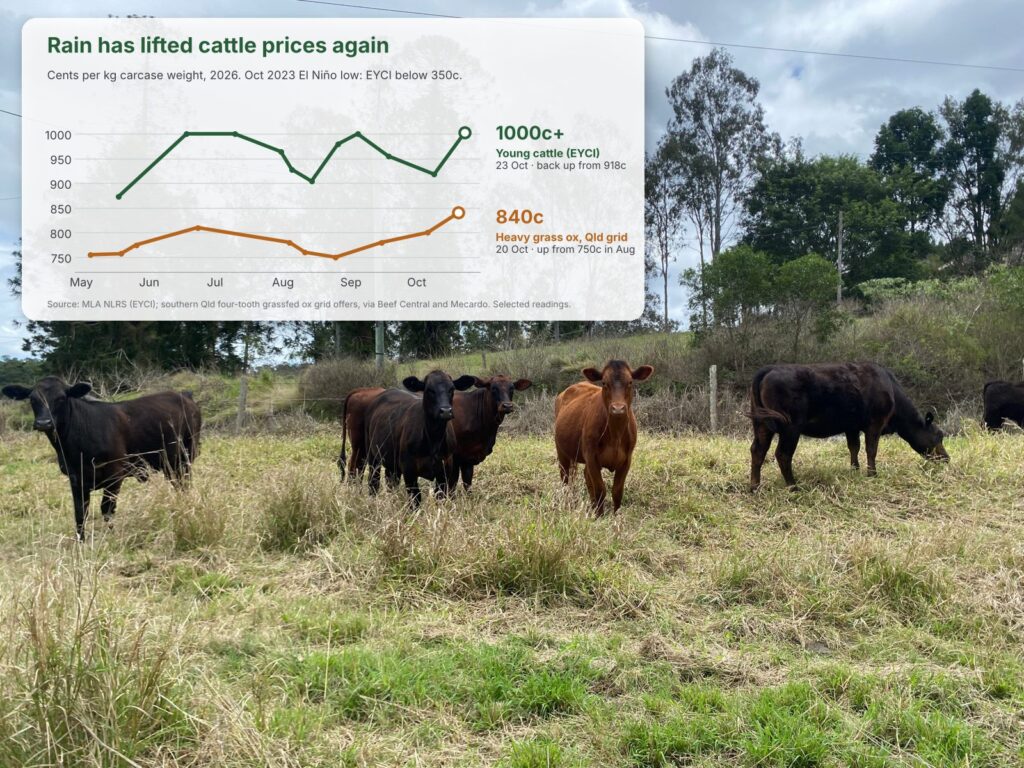
Back in September 2023 an El Niño was declared, the Eastern Young Cattle Indicator (EYCI) dropped below 350c/kg carcase weight by October, and then it rained. The fear did more damage to prices than the weather did.
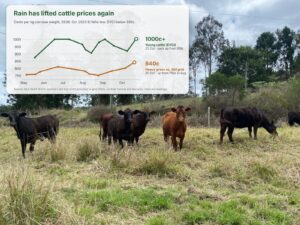
This year we’ve gone into spring from a much better spot. The EYCI hit 1000c/kg in June and again in early September, eased to around 920c in early October, then jumped back over 1000c in the week to 23 October as the rain came through. Heavier cattle have firmed too. Southern Queensland grids for heavy grass ox went from about 750c in late August to 840c by 20 October, and the national heavy steer indicator hit a record 477c/kg liveweight, as the rain tightened up supply.
Around the world, things look different too. The US herd is at a 75-year low and Canada is still tight. The UK has just had one of its worst harvests on record after a hot, dry summer. Ukraine’s wheat exports look like dropping to about 11 million tonnes, with their Black Sea ports knocked about. Diesel is around 285c/L at the pump, and urea is still dearer than this time last year, even though it’s come well off its April high. Less supply around the world and higher costs may help support our prices, whatever the season does here.
Looking ahead
It might go dry, it might keep raining, and prices could hold either way. That makes it a good time to think about which market you’re aiming at and when, how to get the most out of the feed this rain grows, and which pastures may be worth keeping and which might need some work when conditions allow.
Want a second set of eyes on your paddocks? Get in touch with the Agrimix team. We can help you work out what’s worth improving, and when. For shortlisting species that suit your country, Pasture Picker is a great place to start.